


Did you know that Jesus was a capitalist? Did you also know that free market economics is the economic system God wanted, according to the Gospels? I went to Catholic school from first to eighth grade, so I must have missed the day we covered that. But if you listen to the experts on Christian radio like Jonathan Moseley’s “Conservative Commandos” program or Bryan Fischer, they will be happy to fill you in. Turns out Jesus was a “capitalist to the core” and hates socialism as much as he hates sin. Also, Pope Francis was a total chump for making anyone second guess such an ironclad interpretation of the bible.
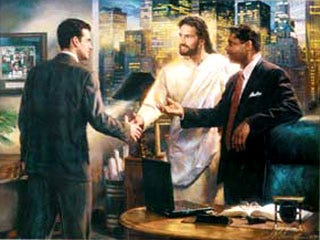
These views are not at all uncommon or new in modern America. Calvinist doctrines going back to founder John Calvin in the sixteenth century say that wealth is evidence of God’s blessing. Max Weber credited Calvinists with helping kick-start capitalism itself in his 1904 book The Protestant Ethic and the Spirit of Capitalism. Likewise, the Prosperity Gospel, personified in the mega-rich ministries of Oral Roberts or Joel Osteen, teaches that Jesus came to earth to minister to our material needs and that those with enough faith will be rewarded with wealth and power. A large network of evangelical leaders known as the Coalition on Revival has declared, “A free market economy is the closest approximation in this fallen world to the system of economy revealed in the Bible.”
So where is the evidence that Jesus was a hardcore supporter of an economic system that didn’t develop until more than a thousand years after he left earth? The bible of course. The parable of the workers in the vineyard, from Matthew 20 and mention of property in Luke 15 and 16 are taken as proof that Jesus supported property rights. In Luke 12:13, when someone asked Jesus to help decide a family inheritance dispute, he responded “Man, who appointed Me a judge or arbitrator over you?” This is interpreted as Christ’s complete rejection of any redistribution of wealth. But the biggest evidence pro-capitalist Christians always summon when proving how much Jesus loved capitalism is Matthew 25, the parable of the talents, or bags of gold.
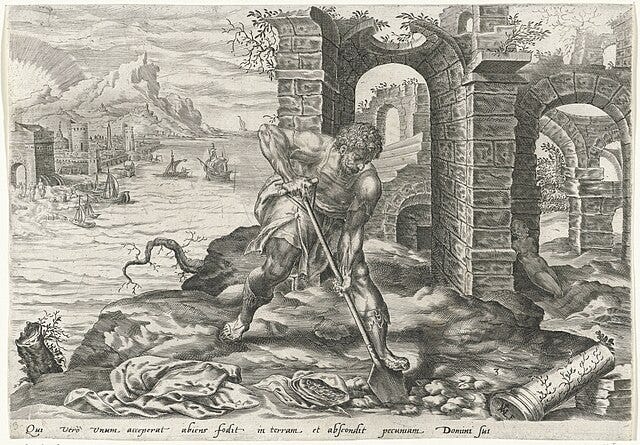
You may remember this story. Jesus tells how a rich man was leaving on a long journey and asked three of his slaves to manage his money while he was away. To the first he gave five talents, to the next he gave two, and the final servant got just one. This was not a small responsibility – a single talent’s value in today’s money would be about $500,000 dollars. The servants who got five and two bags of gold successfully managed to double their money. The one who got just a single bag of gold buried it in a hole to keep it safe. When the master came back the slaves who doubled their money proudly let him know and he gave them both a big pat on the back saying “Well done, good and faithful servant!” When the slave who had not invested his single talent copped to hiding it in a hole because he was scared, his master blasted him, saying “You wicked, lazy servant!” The least he could have done was give it to the bankers and get interest on it! The master continues, “So take the bag of gold from him and give it to the one who has ten bags. For whoever has will be given more, and they will have an abundance. Whoever does not have, even what they have will be taken from them.”
In this story we have Jesus explicitly endorsing the concept of paying interest! Not only that, Bryan Fischer describes how Jesus is also telling us that, “The owner of the capital is free to invest it as he chooses and to entrust his private resources to anyone he wishes… Laziness is punished rather than rewarded, and resources are not involuntarily transferred from the producers to the non-producers but the other way round.” Well, when you put it like that, Christ’s message and Milton Friedman’s are virtually interchangeable! Never mind that Fischer’s interpretation requires a particularly literal reading of scripture to work, completely ignoring that this is called a “parable” and, like other parables in the bible, is metaphorical in nature.

What’s curious is that this parable is understood very differently by modern Americans today than it would have been by its original ancient audience. Retired professor Richard L. Rohrbaugh points out that while a modern reader would applaud the first two slaves’ investing acumen, a person living during the time of Christ would have condemned them for profiting at someone else’s expense. Doubling their money would have been considered shameful because in ancient Mediterranean cultures to seek more meant someone else got less, “Thus honorable people did not try to get more, and those who did were automatically considered thieves…” What the master did in this story was fairly common practice at the time because slaves were held to a different standard than everyone else. A slaveholder could supposedly keep his hands clean by handing money over to a slave to invest. In the eyes of an ancient person hearing this story, the third slave who buried the gold would have been the one who acted most honorably because he did not use that money to take from someone else. Even getting interest on that gold, as the master suggested, was forbidden in the Torah (Deuteronomy 23:19–20). And while some may interpret this story as Jesus giving tacit approval to demanding interest, he explicitly contradicted that interpretation in Luke 6:35 saying people should love their enemies and lend to them expecting nothing in return.
If the ancient audience who first heard Christ’s parable of the five talents understood that the “lazy” slave was actually the only one who acted with honor, this changes the contours of the message quite a bit. In that case, maybe the message is that doing the right thing, the morally right thing that God wants you to do, isn’t always recognized or appreciated. It might upset your boss and you might face earthly punishment or retribution for choosing not to do what you are asked, even if it’s your job. But even if the people around you don’t understand why you’ve made this choice, God does. And even though you may be punished on earth for doing what other people consider wrong or inconvenient, you will be rewarded in heaven. This interpretation seems much more consistent with Christ’s overall message than a literal reading that somehow gives Jesus credit for inventing capitalism.
Jesus was no believer in the status quo. His essential economic message was essentially that the rich and poor should trade places. You don’t have to go digging to find passages where Jesus was critical of rich people. There is the famous one where he says that it would be easier for a camel to pass through the eye of a needle than a rich person to enter the kingdom of heaven (Matthew 19:24). In Mark’s version of that same story, he tells the rich man that if he wants to get into heaven he should “go, sell all that you have and give it to the poor.” Jesus specifically contradicts those who believe he wants us to have material wealth on earth in Matthew 6:19 saying, “Do not lay up for yourselves treasures on earth, where moth and rust destroy and where thieves break in and steal, but lay up for yourselves treasures in heaven, where neither moth nor rust destroys and where thieves do not break in and steal. For where your treasure is, there your heart will be also.” Then, just a few verses later: “No one can serve two masters… You cannot serve God and money.”
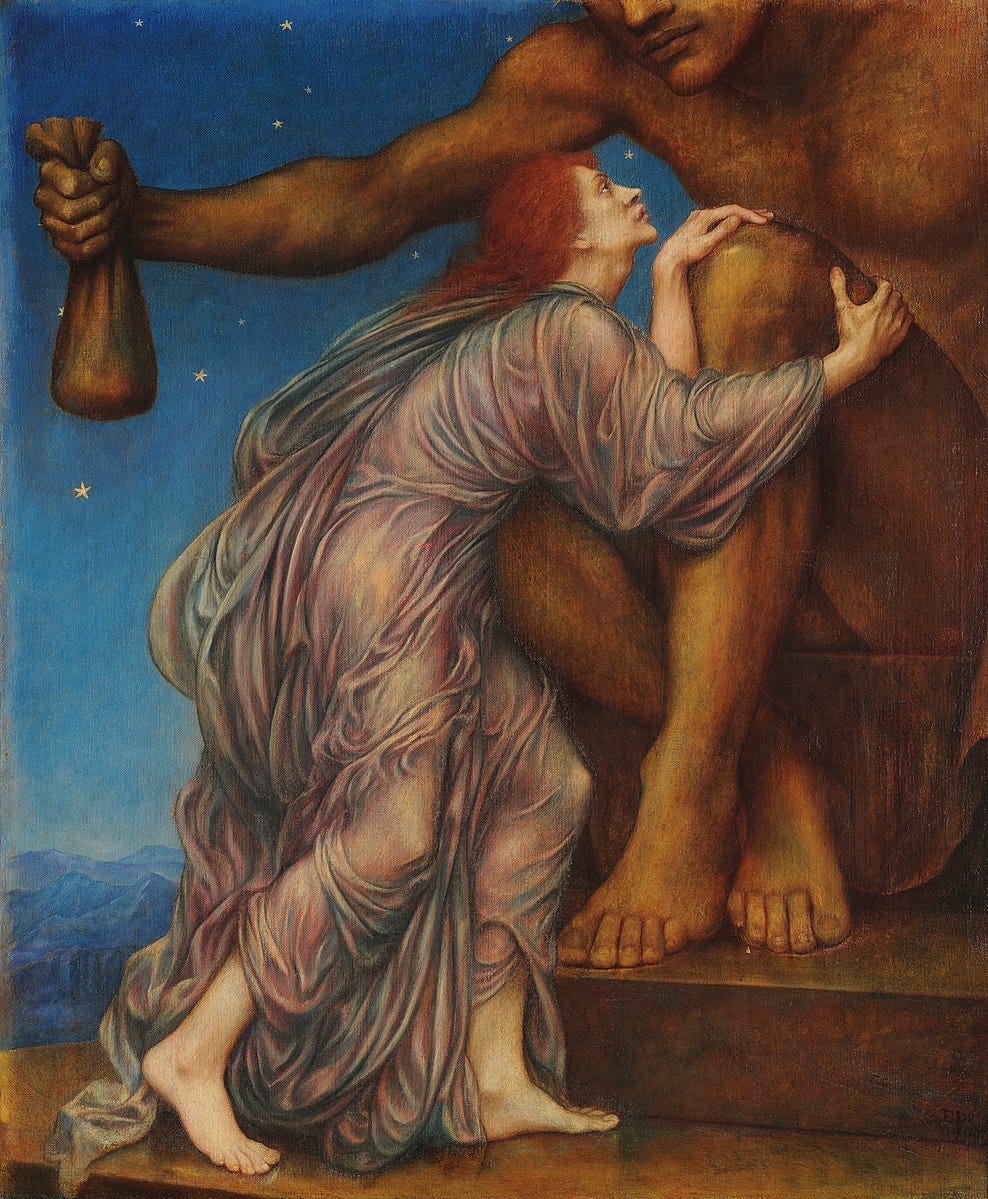
Therefore, those who would argue that Jesus was actually a capitalist unintentionally prove that they don’t know anything about capitalism, nor do they know anything about Jesus. For Jesus to be a capitalist, it would be necessary for him to reject the notion that people should love one another in the way they love themselves – his central message - and instead instruct us to simply love ourselves. It is ironic that so many should claim that the United States is a Christian nation while also embracing its distinction as the world’s largest, most powerful capitalist economy. Christianity is the antithesis of capitalism; they are naturally in conflict with one another. Free market theory, the purest modern expression of capitalism, should therefore be considered an enemy of the Christian faith.
Please give a like, comment, restack, and share to help other people find my Substack.
Merry Christmas, peace on earth, many happy returns, and as I always say, let’s make them pay.


